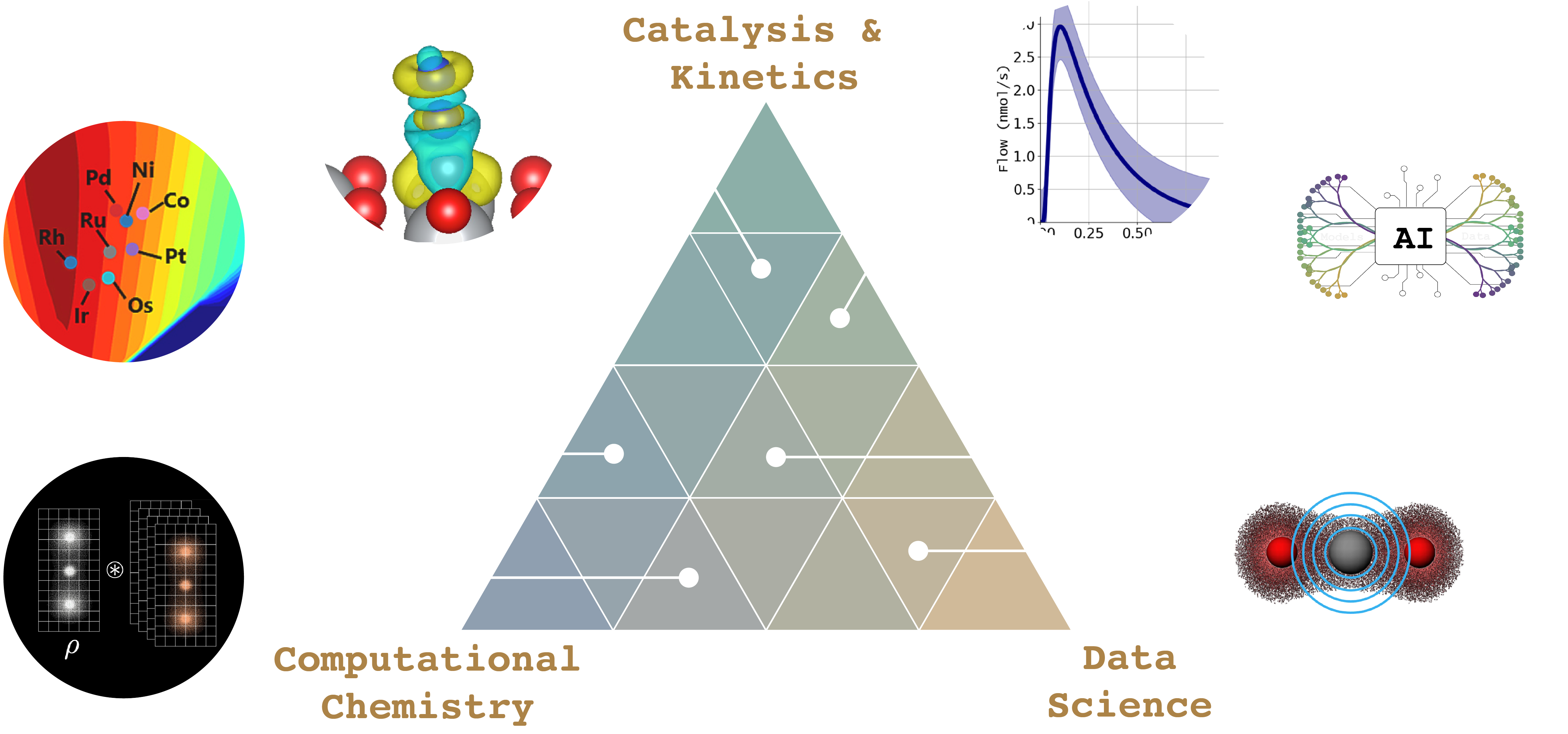
Heterogeneous catalysis is an inherently multiscale problem. At the smallest scale, quantum mechanics governs how electrons rearrange when molecules bind to a surface — and those interactions determine whether a reaction is fast or slow, selective or not. Those atomic-level rates then feed into reactor-scale models that describe how gases flow, mix, and react in industrial equipment. And ultimately, the performance of reactors shapes outcomes at the societal scale: the cost of fertilizers, the feasibility of clean fuels, the viability of carbon capture. Our group works across this entire hierarchy. We develop and apply computational methods at each scale — from new exchange-correlation functionals for quantum chemistry to machine-learned force fields for atomic simulation to neural-network tools for reactor kinetics — and we work to connect the scales to each other. Along the way, we build open-source software tools, including SPARC (electronic structure) and AMPTorch (machine learning potentials), that make these methods accessible to the broader research community.
Analysis of Catalytic Reactions
When a chemical reaction happens on the surface of a catalyst, it involves a sequence of elementary steps — molecules adsorbing, bonds breaking and forming, products desorbing — each governed by the atomic-scale structure of the surface. Density functional theory (DFT) lets us simulate these steps from first principles, computing the energies of adsorbed intermediates and the barriers separating them to build a complete picture of how a reaction network unfolds. We apply these tools to understand catalytic reactions across a range of application domains, including the fixation of atmospheric nitrogen into fertilizers and fuels, the conversion of biomass-derived molecules into valuable chemicals, and the emerging field of mechanochemistry, where reactions are driven by mechanical force rather than heat or light. By connecting computed reaction mechanisms to experimental observations, we aim to answer the question of why a given catalyst works — and use that understanding to guide the design of better ones.
Representative Publications
- Huang et al., JACS Au (2023). Formation of Carbon-Induced Nitrogen-Centered Radicals on Titanium Dioxide under Illumination.
- Comer et al., J. Am. Chem. Soc. (2018). The Role of Adventitious Carbon in Photo-catalytic Nitrogen Fixation by Titania.
- Comer et al., Joule (2019). Prospects and Challenges for Solar Fertilizers.
- Najmi et al., ACS Catalysis (2020). Pretreatment Effects on the Surface Chemistry of Small Oxygenates on Molybdenum Trioxide.
- Chang & Medford, J. Phys. Chem. C (2021). Application of Density Functional Tight Binding and Machine Learning to Evaluate the Stability of Biomass Intermediates on the Rh(111) Surface.
- Yu et al., JACS Au (2024). Evaluating the Role of Metastable Surfaces in Mechanochemical Reduction of Molybdenum Oxide.
Data-driven Integration of Computation and Experiment
A fundamental challenge in catalysis research is that the quantities we care most about — the rates of individual elementary reaction steps — cannot be measured directly. Experiments report overall conversion and selectivity, while theory predicts energies and barriers. Connecting the two requires careful statistical reasoning and model-building. We develop and apply data science, machine learning, and uncertainty quantification methods to bridge this gap. This includes building microkinetic models that translate DFT-computed energetics into predicted reaction rates, propagating uncertainties from the quantum-chemistry level all the way through to experimental observables, and using model-based design of experiments to choose the measurements that will be most informative. We are also exploring how artificial intelligence can accelerate this process, from using AI to interpret complex multimodal datasets to integrating machine-learned models within multiscale simulation pipelines. The goal is to move from qualitative mechanistic stories to quantitative, predictive descriptions of catalytic performance that can be directly tested and refined against experiment.
Representative Publications
- Medford et al., ACS Catalysis (2018). Extracting Knowledge from Data through Catalysis Informatics.
- Kreitz, Lott, Medford et al., Angew. Chem. Int. Ed. (2023). Automated Generation of Microkinetics for Heterogeneously Catalyzed Reactions Considering Correlated Uncertainties.
- Yonge, Gusmão, Fushimi, Medford et al., Ind. Eng. Chem. Res. (2024). Model-Based Design of Experiments for Temporal Analysis of Products (TAP).
- Medford et al., arXiv preprint (2025). Prospects for Using Artificial Intelligence to Understand Intrinsic Kinetics of Heterogeneous Catalytic Reactions.
Design of Exchange-Correlation Functionals for Surface Chemistry
Every DFT calculation requires an exchange-correlation (XC) functional — an approximation that accounts for the quantum mechanical interactions between electrons. The catch is that no single functional is accurate for all types of chemistry: the approximations that work well for a metal surface are often poor for a gas-phase molecule, and vice versa. Since adsorption sits right at the interface between a solid and a molecule, getting adsorption energies right is especially sensitive to this choice. We work to develop new XC functionals that achieve balanced accuracy across all three regimes — molecules, solids, and surfaces — using both machine-learning approaches, where specialized convolutional features are used to learn the exchange-correlation energy from electronic structure data, and physics-based approaches grounded in many-body quantum theory. We also benchmark existing functionals against high-quality reference data for catalytically relevant reactions, providing practical guidance to researchers on which methods are reliable for which systems. This work underpins the accuracy of all our DFT-based studies.
Representative Publications
- Lei & Medford, Phys. Rev. Materials (2019). Design and Analysis of Machine Learning Exchange-Correlation Functionals via Rotationally Invariant Convolutional Descriptors.
- Sahoo, Xu, Lei, Medford et al., ChemPhysChem (2023). Self-Consistent Convolutional Density Functional Approximations: Application to Adsorption at Metal Surfaces.
- Kim, Yu, Tian, Medford et al., J. Phys. Chem. C (2024). Assessing Exchange-Correlation Functionals for Heterogeneous Catalysis of Nitrogen Species.
- Bhowmik, Medford & Suryanarayana, J. Chem. Phys. (2025). Real-Space Hubbard-Corrected Density Functional Theory.
- Medford et al., arXiv preprint (2026). Optimization of Random Phase Approximation Calculations for Improved Energies of Molecules, Solids, and Surfaces.
High-throughput Computational Screening
There are millions of possible catalyst and material compositions, but experimentalists can only test a small fraction of them. Computational screening offers a way to evaluate many candidates quickly and focus experimental effort on the most promising ones. The challenge is that rigorous quantum chemistry calculations are too slow to apply at scale, so screening requires a hierarchy of models: fast, approximate methods that can scan broad chemical spaces, combined with higher-fidelity calculations to validate the top candidates. We develop and apply this kind of computational funnel to accelerate discovery in two main areas. In heterogeneous catalysis, we screen materials for reactions where selectivity and activity depend critically on surface chemistry, such as nitrogen fixation and hydrocarbon conversion. In gas separations, we screen porous materials — particularly metal-organic frameworks — for applications like direct air capture of CO₂. A key part of this work is building the datasets and machine-learning models needed to make screening fast enough to be useful, while retaining enough physical accuracy to make reliable predictions.
Representative Publications
- Tian, Comer & Medford, ChemSusChem (2023). Screening and Discovery of Metal Compound Active Sites for Strong and Selective Adsorption of N₂ in Air.
- Choi, Sholl & Medford, J. Chem. Phys. (2022). Gaussian Approximation of Dispersion Potentials for Efficient Featurization and Machine-Learning Predictions of Metal–Organic Frameworks.
- Sriram, Choi, Yu, Medford et al., ACS Central Science (2023). The Open DAC 2023 Dataset and Challenges for Sorbent Discovery in Direct Air Capture.
- Sakai, Furikado & Medford, J. Catalysis (2025). Rational Design of Selective Catalysts for Ethylene Hydroformylation via Microkinetic Modeling and Universal Neural Network Potentials.
- Choi, Sholl & Medford, Mach. Learn.: Sci. Technol. (2025). D-MOPH-25: Diverse MOF–Molecule Pairs for Henry’s Constants Prediction.
Development of Machine-learned Force Fields
Molecular dynamics simulations track the motion of every atom in a system over time, revealing how structures evolve, how reactions proceed, and how materials behave at finite temperature. The bottleneck is energy: computing forces on atoms accurately requires quantum chemistry, but quantum chemistry is far too slow to simulate the timescales and system sizes that matter in catalysis. Machine-learned force fields (MLFFs) solve this by training a statistical model to predict atomic energies and forces from local atomic environments, achieving near-DFT accuracy at a fraction of the cost. We develop new methods for building better MLFFs, including more expressive and transferable ways to represent atomic environments, and rigorous uncertainty quantification methods that tell a simulation when it has wandered outside the domain where the model can be trusted. We also develop workflows that combine MLFFs with periodic on-the-fly retraining, so that the model automatically improves as the simulation explores new configurations. These tools are especially important for complex, multi-element systems like catalytic surfaces with multiple adsorbates.
Representative Publications
- Lei & Medford, J. Phys. Chem. Lett. (2022). A Universal Framework for Featurization of Atomistic Systems.
- Hu, Musielewicz, Ulissi et al., Mach. Learn.: Sci. Technol. (2022). Robust and Scalable Uncertainty Estimation with Conformal Prediction for Machine-Learned Interatomic Potentials.
- Kumar, Jing, Pask, Medford et al., J. Chem. Phys. (2023). Kohn-Sham Accuracy from Orbital-Free Density Functional Theory via Δ-Machine Learning.
- Timmerman, Kumar, Suryanarayana & Medford, J. Chem. Theory Comput. (2024). Overcoming the Chemical Complexity Bottleneck in On-the-Fly Machine Learned Molecular Dynamics Simulations.
Analysis of Transient Kinetic Data
Most kinetic measurements in catalysis are done at steady state: you flow gas over a catalyst, wait for the ouput to stabilize, then measure what comes out. This is useful, but it conflates the contributions of many elementary steps and makes it hard to resolve individual rate constants. Transient kinetic experiments take a different approach: by injecting a short pulse of reactant and watching the time-resolved response, you can probe the dynamics of adsorption, surface reactions, and desorption individually. The temporal analysis of products (TAP) reactor is one tool for this kind of measurement, but extracting quantitative kinetic parameters from TAP data is mathematically challenging. We develop computational methods — including physics-informed and kinetics-informed neural networks — that can fit complex microkinetic models directly to transient data, even for reaction networks with many coupled steps. These methods are designed to be both flexible enough to handle real experimental complexity and rigorous enough to provide reliable uncertainty estimates on the fitted parameters, making transient kinetics a more accessible and quantitative tool for mechanistic catalysis research.
Representative Publications
- Gusmão & Medford, Catalysis Today (2022). Kinetics-Informed Neural Networks.
- Yonge, Gusmão, Fushimi & Medford, AIChE J. (2022). Quantifying the Impact of Temporal Analysis of Products Reactor Initial State Uncertainties on Kinetic Parameters.
- Gusmão & Medford, Comput. Chem. Eng. (2023). Maximum-Likelihood Estimators in Physics-Informed Neural Networks for High-Dimensional Inverse Problems.
- Nai, Gusmão, Kilwein, Medford et al., Digital Discovery (2024). Micro-Kinetic Modeling of Temporal Analysis of Products Data Using Kinetics-Informed Neural Networks.